- How To Use Ipad As Midi Keyboard For Garageband Free
- Ipad Garageband Midi Input
- How To Use Ipad As Midi Keyboard For Garageband 1
Start by getting the Lightning to USB Camera Adapter. (For older iPads, the 30-pin to USB Camera Kit also works.)
Get a SMALL USB-based MIDI controller, e.g. 25-key. Some MIDI controllers have batteries to power them, or larger professional keyboard controllers/synthesizers/pianos have their own AC power supply.
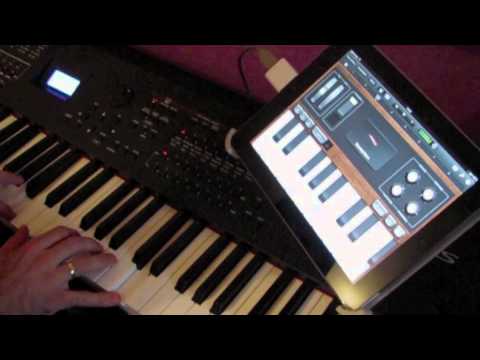
Feb 04, 2013 Connect your iPad to a Midi Controller Keyboard with the Ipad Camera Connexion Kit I plug the M-Audio Oxygen 49 and the Yamaha P-105 with my iPad and make a test with Garageband and Akai Synthstation.
- Jun 26, 2012 How to Connect a MIDI keyboard to Garageband siliconbeats. How to use a USB MIDI Keyboard in GarageBand iOS (iPhone/iPad) - Duration. How To Connect MIDI Keyboard To Garageband.
- In the past, MIDI Keyboards were connected through the use of Pin Drivers, but new MIDI Keyboards usually use USB. If you want to connect an older keyboard into Garageband, you’ll need a MIDI to USB adaptor. What MIDI keyboard should I use for Garageband?
Get a CoreMIDI-compatible app, e.g. Garage Band, Tabletop, NanoStudio, MusicStudio, Thumbjam, etc. IMPORTANT: Launch the app.
Connect you USB cable to the keyboard and the Lightning adapter.
Plug the Lightning adapter into the iPad. IMPORTANT: Always launch the app first before connecting the Lightning adapter! If the keyboard isn't working, unplug and re-plug.
Tap some keys on the keyboard or the control buttons to make sure power is getting to the device.
Troubleshooting: some apps require you to tell them your keyboard is used for input.
Troubleshooting: some apps have 'Learn Mode'. Enter Learn Mode, tap on the part of the screen to 'learn', then press your keyboard or twist a knob to assign it. Exit Learn Mode and play around!
Download GarageBand for PC with Andy the Android Emulator and start recording. GarageBand on PC is now possible with Andy. GarageBand comes with built-in guitar and piano lessons you can try out. If you want to take things a little step further, some Multi-Platinum artists can actually teach you to play some of their original recordings. Jun 21, 2018 GarageBand has long been a useful tool to record music, podcasts and more. Even better, the app is free to download and use on your Mac or iOS devices, making it. Re-download GarageBand Learn to Play Artist Lessons Learn how to resume interrupted or re-download previously purchased Learn to Play Artist Lessons. If you’ve started to download Learn to Play Artist Lessons and the download is interrupted or is incomplete, you can resume the download from the Lesson Store in GarageBand. GarageBand Guitar lessons for PC – Play Like a Pro – GarageBand is one of the popular software used in iOS devices. With the help of this software, he user can create music compositions or podcasts. This software is introduced to us by Apple Inc for using in OS X. Garageband guitar lessons download free download.
Supplies
| 1 | iPad |
| 1 | Lightning to USB Camera Adapter |
| 1 | Small USB MIDI keyboard |
| 1 | CoreMidi-compatible app |
GarageBand User Guide for iPad
You can import audio and MIDI files from your computer and use them in your GarageBand song. You can add:
Audio files to an existing Audio Recorder or Amp track
MIDI files to an existing Keyboard or Drums track
Audio or MIDI files to new tracks
Audio or MIDI files to your song from iCloud Drive or your iPad using the Files app
When you import an audio file, it’s converted to a 44.1 kHz sample rate, 16-bit depth format if the original format is different. Imported audio files don’t follow tempo changes you make in GarageBand.
How To Use Ipad As Midi Keyboard For Garageband Free
When you import a multitrack MIDI file, GarageBand creates a new Keyboard track for each track in the MIDI file. The total number of resulting tracks cannot exceed 32 tracks. You cannot add multitrack MIDI files to cells in Live Loops.
Ipad Garageband Midi Input
Import audio and MIDI files from your computer
On your computer, add the audio or MIDI files you want to import to the GarageBand File Sharing area in the Finder.
In GarageBand on your iPad, set the current song section to Automatic to import the entire audio or MIDI file; otherwise, only the portion of the file that fits the current song section is imported.
After importing the audio or MIDI file, you can make the song section longer, then resize the region so more of it plays.
Tap the Tracks View button to open Tracks view, then tap the Loop Browser button in the control bar.
A message appears asking if you want to move the audio or MIDI files to the GarageBand File Transfer folder.
Tap Move Files.
The files are moved to the GarageBand File Transfer folder.
To preview an audio file, tap it in the list. You can control the preview volume with the slider at the bottom of the list.
Drag an audio or MIDI file from the list to Tracks view. Align the left edge of the file with the bar or beat (on the ruler) where you want it to start playing.
Under the hood, our development team has carefully designed unique “Hardware Profiles” for each supported hardware synthesizer, making the special features of that synthesizer work seamlessly with Omnisphere by translating MIDI messages from the hardware into satisfying sonic results in Omnisphere. This new system allows us to enable sophisticated interactions from a single touch of a knob, including the ability for Omnisphere to automatically switch interface pages, recall entire FX racks, assign multiple scaled parameters and even instantly create complex modulation matrix routings on-the-fly! Sophisticated omnisphere 2 download. This new development system also allows us to add new profiles for new hardware synths in the future. Most importantly, it’s easy for musicians to use - simply select the hardware synth from the drop-down HW menu and Omnisphere is now linked to that hardware synth!Expanded Synthesis CapabilitiesThe new version 2.5 vastly expands the synthesis capabilities of Omnisphere by doubling its voice architecture to Four Layers per patch!
A new region created from the audio or MIDI file is trimmed to the end of the current song section, unless the current song section is set to Automatic. You can make the song section longer or slow down the tempo, then resize the region so that more of it plays.
Import audio and MIDI files with the Files app
Set the current song section to Automatic to import the entire audio or MIDI file; otherwise, only the portion of the file that fits the current song section is imported.
After importing the file, you can make the song section longer, then resize the region so that more of it plays.
Tap the Tracks View button to open Tracks view, tap the Loop Browser button in the control bar, then tap Files.
Tap “Browse items from the Files app,” then locate and tap an audio or MIDI file to import it.
To preview an audio file, tap it in the list. You can control the preview volume with the slider at the bottom of the list.
Drag an audio or MIDI file from the list to Tracks view. Align the left edge of the file with the bar or beat (on the ruler) where you want it to start playing.
A new region created from the audio or MIDI file is trimmed to the end of the current song section, unless the current song section is set to Automatic. You can make the song section longer or slow down the tempo, then resize the region so that more of it plays.
Import audio and MIDI files using Slide Over
How To Use Ipad As Midi Keyboard For Garageband 1
Set the current song section to Automatic to import the entire audio or MIDI file; otherwise, only the portion of the file that fits the current song section is imported.
After importing the file, you can make the song section longer, then resize the region so that more of it plays.
Swipe up twice from the bottom edge of the screen.
The Dock appears.
In the Dock, touch and hold the Files app, drag it towards the upper-right corner of the screen, then let go.
A Slide Over window opens.
Locate the audio or MIDI file you want to import. If the file is in iCloud Drive, tap the Download button to download it before importing.
Touch and hold the file, then drag it from the Slide Over window to Tracks view. Align the left edge of the file with the bar or beat (on the ruler) where you want it to start playing.
A new region created from the audio or MIDI file is trimmed to the end of the current song section, unless the current song section is set to Automatic. You can make the song section longer or slow down the tempo, then resize the region so that more of it plays.