| Module & Plug-in |
|---|
Overview
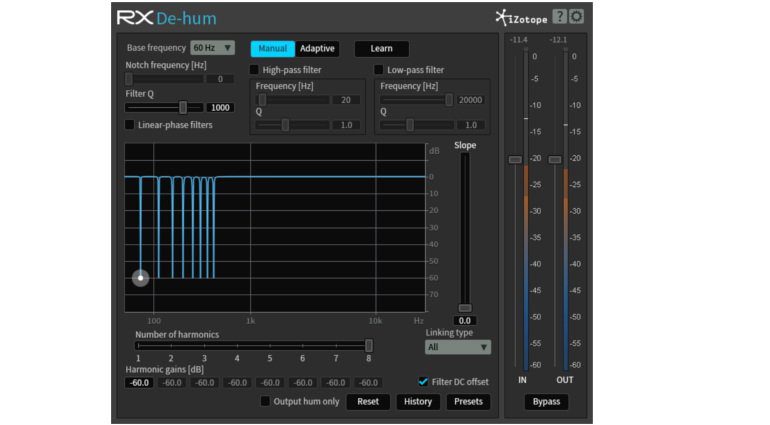
Jul 03, 2014 Hum or buzz can creep into an audio recording unexpectedly. In this video, Mike Thornton shows you how to remove hum or buzz using the Remove Hum and Spectral Denoise modules in RX. Jan 20, 2005 The De-hum module in iZotope’s RX noise reduction software includes a series of notch filters that can be set to remove both the base frequency of the hum (usually 50 or 60 Hz), as well as harmonics that may have resulted. RX Elements is the perfect introduction to the world of audio repair, offering essential tools to remove noise, clipping, clicks, and other problems that plague small studios. Get four of our best repair tools, a standalone audio editor, and the brand new Repair Assistant at an affordable price.
De-reverb gives you control over the amount of ambient space captured in a recording. It can make large cathedrals sound like small halls and make roomy vocals sound like they were recorded in a treated space.
Izotope Rx De Hum Lyrics
De-reverb processes audio according to the reverberant/direct ratio (also known as wet/dry ratio) detected in the signal. It can learn your audio to suggest some frequency and decay time settings, or you can estimate these yourself.
- Sep 24, 2018 Learn how to use RX 7 for music to solve common audio issues. Isolate a vocal for a remix with Music Rebalance, remove guitar string squeaks with Spectral Repair, fix clipped audio, hum.
- De-reverb gives you control over the amount of ambient space captured in a recording. It can make large cathedrals sound like small halls and make roomy vocals sound like they were recorded in a treated space. De-reverb processes audio according to the reverberant/direct ratio (also known as wet/dry ratio) detected in the signal.
- This tool includes a series of notch filters that can be set to remove both the base frequency of the hum (usually 50 or 60 Hz) as well as any harmonics that may have resulted. The De-hum plug-in is effective for removing hum that has up to seven harmonics above its primary frequency. Some very high frequency buzz can also be removed with the De-click plug-in.
Visual Example #. De-plosive has been developed to minimize plosives from letters such as p, t, k, and b, in which strong blasts of air create a massive pressure change at the microphone element, impairing the sound. Plosives are typically audible as low-end thumps.
Controls
- LEARN: Teaches De-reverb how much reverb is in your signal.
- The Learn feature analyzes the signal and determines the wet/dry ratio per frequency of your signal, as well as the overall rate of decay of reverb.
- When the Learn operation completes, the Reverb Profile and Tail Length controls will be set to their suggested values.
- The Learn operation can be performed on any reverberant audio.
Recommendation
Your download will start in a few seconds. If it does not,.Would you like to receive notifications about VirtualDJ PRO updates by email? Download windows 7 gratis completo.
Mar 04, 2020 iZotope VocalSynth 2.01 Crack + Torrent Download For Windows + Mac (2020) iZotope VocalSynth 2.01 Crack is designed to open up an expansive array of vocal potential. This software also allow the user to produce complex, interesting and unique vocal effects. Nov 04, 2018 iZotope VocalSynth v2.01 Win & MacOSX Size 220 Mb. VocalSynth 2 Vocals, Evolved. VocalSynth 2 is an immersive vocal experience that adapts and evolves with your unique style and opens up a world of vocal possibilities. The evolution of vocals Elevate your vocal productions with iZotope’s most unique plug-in experience for vocals. IZotope – VocalSynth 2.00 (VST, AU) MacOSX Description: VocalSynth 2 is an exciting vocal experience that adapts and develops with your unique style and opens up a. IZotope VocalSynth 2.01 macOS. Ready for a transformative vocal experience? With VocalSynth, iconic vocal sounds from decades past and the wild vocal sounds you’ve only heard in. Izotope vocalsynth 2 mac torrent.
- We strongly recommend using the Learn feature on a selection of audio that starts with some noise floor (or room tone), is several seconds long, and includes both the direct signal and its reverberant tails.
- We strongly recommend using the Learn feature on a selection of audio that starts with some noise floor (or room tone), is several seconds long, and includes both the direct signal and its reverberant tails.
- The Learn feature analyzes the signal and determines the wet/dry ratio per frequency of your signal, as well as the overall rate of decay of reverb.
- METERING
- The top meter shows a comparison between the input and output signal energy over the past five seconds of playback.
- The bottom meter shows the amount of reverb reduction over time. It is the difference between input and output plotted on a flat line.
- Both of the meters together give you an idea of what De-reverb considers reverb and help you refine your settings.
- The top meter shows a comparison between the input and output signal energy over the past five seconds of playback.
- REDUCTION: Controls the applied amount of De-reverb.
- Larger amounts mean more reverb is removed.
- Smaller amounts perform less processing.
- This control represents the target wet/dry ratio for processing. In other words, if it is set very high, it will treat the signal as though it has more reverb and process it more.
Note: Negative Reduction Values
- Negative Reduction values will increase the amount of reverb in the signal.
- Negative Reduction values will increase the amount of reverb in the signal.
- Larger amounts mean more reverb is removed.
- REVERB PROFILE: Controls the amount of De-reverb effect applied per band.
- These controls are set automatically by the Learn feature.
- If a group of reverberant tones are more prominent in a signal, increase the control for that band.
- Generally you want to set these controls to match the reverb originally present in your signal. For example, if reverb takes longer to decay (or is more present) in a particular band, set that control higher.
- These controls can also be used to address more prominent ringing or resonant groups in signals. For example, increasing the profile control for low frequencies can remove muddiness from a resonant bass guitar, while increasing the high band control can curtail ringing sibilance in live vocal recordings.
- These controls are set automatically by the Learn feature.
- TAIL LENGTH: Controls the decay of De-reverb processing. This control is an approximation of RT-60, the rate of time it takes for a reverberant signal to decrease in amplitude by 60 dB. This is automatically set by the Learn feature.
- Increase this control if reverb tails reappear after processing, or if early reflections are too apparent.
- Decrease this control if reverb tails and noise floors sound over-processed, or if the processed audio sounds dull.
- Setting this control to the minimum value is effective at processing early reflections.
- Increase this control if reverb tails reappear after processing, or if early reflections are too apparent.
- ARTIFACT SMOOTHING: Controls the frequency accuracy of De-reverb processing.
Artifact Smoothing Default Value Note
- Because reverb is generally smooth across the frequency spectrum, the default value of this control is very high.
- However, if you need more accuracy to address issues like resonant tones in a room, you can decrease this control. The tradeoff is generally more artifacts from strong processing, so you may have to balance adjusting this and the Reduction control.
- Because reverb is generally smooth across the frequency spectrum, the default value of this control is very high.
- ENHANCE DRY SIGNAL: Increases the level of the direct signal.
- Boosting the direct signal can help create more dynamic range in the signal, and is a good option to try when working with voice or transient material.
- Enabling this option can also help prepare material for later de-noising.
- Boosting the direct signal can help create more dynamic range in the signal, and is a good option to try when working with voice or transient material.
- OUTPUT REVERB ONLY: Changes the output of De-reverb from the processed signal to the wet reverberant signal.
- This is useful for monitoring the processing to get better results. Hearing just the reverb helps you understand the impact of controls like Reduction, Reverb Profile, Tail Length, and Artifact Smoothing.
- When this option is enabled, the output may not sound much like reverb because it is the difference of processing against the original signal, with some enhancement to expose more of the reverb apparent in the recording.
- This is useful for monitoring the processing to get better results. Hearing just the reverb helps you understand the impact of controls like Reduction, Reverb Profile, Tail Length, and Artifact Smoothing.
More Information
What are early Reflections?
Early reflections are the rapid echoes of a direct sound from a nearby surface. They are often distinct from the rest of a reverberant tail because they have a lot of energy but end quickly. Early reflections typically comprise the first 5 to 100 milliseconds of a reverb tail.
Using De-reverb as a real-time plug-in
Izotope Rx De Human
- De-reverb is available as a VST/AU/RTAS/AAX real-time plug-in.
- However, due to the complexity of this processing, it can be resource intensive.
- To achieve high-quality results, it is always best to bring the audio file in question into RX Audio Editor (via RX Connect or by opening it directly), applying De-reverb, and then returning the file back to your original session.
Tips for Learning a Reverb Profile
- To find the best settings for your signal quickly, find about five seconds of audio that starts with noise and has both direct signal and reverberant tails.
- If you can find enough direct signal and reverberant tails to fill the De-reverb signal trace meter while using Learn, you will probably get a good reverb profile.
- If you can find enough direct signal and reverberant tails to fill the De-reverb signal trace meter while using Learn, you will probably get a good reverb profile.
- Direct signal, reverberant tail, and noise are all important to help De-reverb understand your audio and set its controls appropriately. It needs to understand the ratio of dry signal to reverberant signal, how long reverb tails last, and where the noise floor of your signal is (to avoid excessive processing).
- If you have trouble getting good results from the Learn feature, you can try:
- learning on transient broadband audio, like drums, claps, or coughs
- learning on any audio that is obviously reverberant
- learning for a longer amount of time. Most reverb can be analyzed in a few seconds, but some reverb profiles can require up to ten seconds of analysis.
- learning on transient broadband audio, like drums, claps, or coughs
- Does De-reverb processing sound unnatural?
- **If the output of De-reverb sounds unnatural after Learning, try slowly decreasing the reduction control.
- **If the output of De-reverb sounds unnatural after Learning, try slowly decreasing the reduction control.
Visual Example of De-reverb processing
De-reverb has the effect of sharpening a signal in time. You can see this transition in the spectrogram: reverberant audio looks blurred, and cleaned audio appears more focused.
Here, a recording of a distant speaker (left) has had its long tails processed (center) before another De-reverb pass with shorter tail lengths to tackle the early reflections (right):
Tips for dealing with complicated reverbs
If the audio you are working with has a very complex reverb, such as a reverb with apparent early reflections, you may get better results after trying a few passes of De-reverb.
- First, start by training the De-reverb and set the Reduction amount to a value that yields good results on the long reverberant tail.
- After processing, Learn a new reverb profile and try reducing the level of early reflections: set the Tail Length control to 0.5, Artifact Smoothing around 3.0, and increase Reduction.
- A combination of De-reverb and Spectral De-noise can be used to tame very reverberant signals. It does not matter whether you process with De-reverb or Spectral De-noise first.
| Module & plug-in |
|---|
Overview
De-plosive is able to intelligently identify plosives, and then separate and remove them from the audio signal, while preserving the fundamental frequency and harmonics of the dialogue.
Controls
- SENSITIVITY: This helps adjust the sensitivity with which De-plosives detects issues. If the plosives in your audio are not being effectively reduced, try increasing the value of this parameter to more easily detect plosives. This parameter has a greater effect than Strength on the overall effectiveness of plosive reduction.
- STRENGTH: This controls the amount of plosive reduction that occurs. Higher values will reduce the plosives more deeply, but may also have a negative effect on the useful speech signal.
- FREQUENCY LIMIT [Hz]: This allows you to set the highest frequency that will be reduced. Though some plosives may reach into the 300–400 Hz range, most do not, and this helps avoid processing any audio in which plosives are not present.
More Information
Visual Example
De-plosive has been developed to minimize plosives from letters such as p, t, k, and b, in which strong blasts of air create a massive pressure change at the microphone element, impairing the sound. Plosives are typically audible as low-end thumps, anywhere between 20–300 Hz, sometimes as high as 500 Hz.
Considerations when using de-plosive on audio that has already been filtered
De-plosive uses a frequency band between 20 to 80 Hz to detect plosives. If the audio has already been filtered with a high-pass filter, it is possible that plosive detection will not work correctly. So, it is recommended to use De-plosive on audio that has not yet been filtered.